

Key London Underground information
-
The London Underground network is divided into nine zones. Central London is in Zone 1.
-
The Tube network has 11 lines.
-
The Tube fare depends on how far you travel, the time of day and the payment method you use.
-
Oyster cards or contactless payments are the cheapest ways to pay for Tube journeys.
-
Tube services usually run from 5am until midnight.
-
Night Tube services run on selected lines on Friday and Saturday evenings.
Updated for 2026
Getting around London is straightforward thanks to the city’s extensive public transport network, with the London Underground at its core.
The Tube, along with the Docklands Light Railway (DLR) and local trains – including the London Overground, the Elizabeth line and National Rail services – connects Greater London, helping visitors reach attractions, restaurants and neighbourhoods quickly and efficiently.
Greater London is served by 11 Tube lines, providing comprehensive coverage across the city.
London Underground trains generally run between 5am and midnight from Monday to Saturday, with slightly reduced hours on Sundays. A Night Tube service operates throughout the night on Fridays and Saturdays on the Victoria, Central, Jubilee, Northern and Piccadilly lines.
This London Underground guide draws on official Transport for London (TfL) sources and insights from real visitor experiences, presenting practical advice for navigating the Tube efficiently and safely. Our recommendations are designed to help both first-time visitors and experienced travellers move around London with confidence.
Jump to a section:
London Underground overview: zones, lines and how it works
What is the London Underground (and why is it called "the Tube")?
The London Underground is often called the Tube because of the shape of the tunnels. The London Underground is one of the oldest metro systems in the world, opening in 1863. When the Central Line Railway opened in 1900, it was called the Twopenny Tube, referencing the price of a ticket. The nickname has stuck ever since!
London Underground zones and lines explained
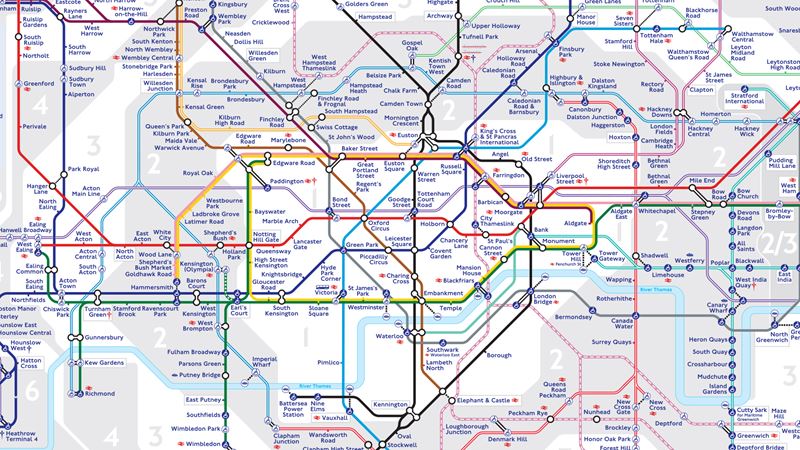
London's public transport network is divided into nine travel zones. Zone 1 is in central London and zones 6 to 9 are on the outskirts of the city.
The London Underground network has 11 lines: Bakerloo, Central, Circle, District, Hammersmith & City, Jubilee, Metropolitan, Northern, Piccadilly, Victoria and Waterloo & City. The network covers a total of 272 stations and it is operated by Transport for London (TfL).
London's Elizabeth line connects London Heathrow Airport and Reading to Shenfield and Abbey Wood via major central London Underground and rail stations, including Paddington, Liverpool Street and Canary Wharf stations.
View, download and find out more about the London Tube map.
Free London Tube maps and visitor information
Transport for London (TfL) produces free maps and guides to help you get around. You can pick up a London Underground map upon arrival at any London Tube station. London travel information centres sell tickets and provide free maps, and you'll find centres at Victoria, Piccadilly Circus and King's Cross St Pancras stations, as well as at Visitor Information Centres.
For more detailed travel information, including the best stations to use and suggested routes, you can use Transport for London’s Journey Planner.
How to pay and payment options on the Tube
Which Tube payment method is best for you?
The easiest and cheapest way to travel on the London Underground is by using pay as you go, with a Visitor Oyster card*, Oyster card, Travelcard or contactless payment card.
| Payment method | Who it's best for |
|
Visitor Oyster card |
Short-stay tourists who want a hassle-free option (which can be sent to your home address before you arrive in London). |
| Oyster card | Regular visitors or residents staying longer. |
| Contactless payment card | Visitors and residents who don't want to carry a separate card (check with your bank about additional charges if your card was issued outside the UK). |
| Travelcard | Visitors or residents planning multiple journeys in central London. |
Check out our guide to Oyster cards and Visitor Oyster cards in London.
Peak and off-peak fares explained
Different travel fares apply depending on what day of the week and what time of day you travel on the London Underground, and which zones you travel through. Peak and off-peak fares are charged based on the time you touch in.
When using pay as you go on the London Underground, peak and off-peak fares are charged at the following peak and off-peak times:
- Peak fares: Monday to Friday (excluding public holidays) between 6.30am and 9.30am, and between 4pm and 7pm.
- Off-peak fares: at all other times and if you travel from a station outside Zone 1 to a station in Zone 1 between 4pm and 7pm, Monday to Friday.
For more details about London Tube prices, see the latest fares on the Transport for London website.
Discounts and concessions
Free travel and discounts are available for children, students and older travellers.
Check out this guide to cheap travel for more money-saving tips when travelling in London. If you plan on travelling around London to do some sightseeing and visit some of London's best attractions, a London Pass* could save you money.

Buy a Visitor Oyster Card
Order online and arrive ready to go!How to use the London Underground: step-by-step guide
Best apps for navigating the London Underground
The TfL Go and Citymapper London apps are the most widely used and efficient mobile applications to travel on the London Underground network.
Download the TfL Go app on your smartphone to top up your pay-as-you-go credit, buy travelcards, check your balance and find the best routes to reach your destination.
The Citymapper app simplifies public transport in London by providing live, up-to-the-minute information and multiple route options. Features include disruption notifications, offline maps, transport ticket prices, taxi fares and more.
How to tap in and out correctly

To travel on the London Tube, simply tap your phone, contactless card, Oyster card or Visitor Oyster card on the yellow card reader when you start your journey and again when you end your journey. If you do not tap in and out every time, the system will not know which journey you have made, and you may be charged a maximum fare.
Finding the right platform and train direction
Once you've worked out what Tube line to take to get to your chosen destination, head to the correct platform, which depends on the direction you are heading (northbound, southbound, eastbound, westbound).
The Tube trains' direction is indicated on station signs directing you to the platforms, on digital screens announcing incoming trains, as well as on the front of London Underground trains.
Digital screens on Tube platforms also display arrival times and service updates, essential for navigating the London Underground during peak times. You can also look out for poster-sized maps on station walls, platforms and above seats within the train to help direct you to your destination.
On the train: announcements and interchanges
Once onboard, listen for announcements identifying the next stop and any interchange opportunities.
Exiting the station and connections
When it's time to exit the train, look for signs directing you to street level or connecting services inside the station.
Travel tips and etiquette on the Tube
London Underground travel etiquette
- Stand on the right when using escalators.
- Wait for passengers to leave the train before boarding.
- Move down inside the Tube carriages while travelling so you don't block the doorway for other passengers.
- Stand behind the yellow line while waiting on the platform.
- Offer your seat to anyone who is unwell, elderly, pregnant or travelling with small children.
Tips for avoiding crowds and rush hour
- Avoid travelling during morning and evening rush hours (weekdays from 7am to 8.45am and 4.30pm to 6.45pm).
- Trains run frequently so there’s no need to rush for the train, just wait for the next available service.
Useful practical tips
- Check the front of the train for the destination.
- Mind the gap when boarding or exiting the train!
- Hold onto the rails if you are standing during your journey.
- If you’re carrying luggage, board at the raised platform areas for level access on to the train.
- Download the TfL Go app for live train times and to plan your journey, or visit one of the TfL Visitor Centres.
London Tube operating hours
| Service | Operating hours | Notes / exceptions |
| Tube (standard) |
Usually from 5am to around midnight (Monday to Saturday) |
Reduced hours on Sundays; exact last train times vary by line and station – check signage, ask staff or use the TfL Journey Planner for live times. |
| Night Tube | Friday and Saturday nights | Victoria, Central, Jubilee, Northern and Piccadilly lines only – check our full Night Tube guide for more information. |
Accessibility on the London Underground
Access to most Tube stations is via staircases or escalators, but some London Underground stations have step-free access. The Tube map indicates which stations are step-free.
Find out more in our guide to accessible public transport in London and check out Transport for London's accessible travel guides.

Buy your London Pass*
Save time and money.Common route questions
How to travel between Heathrow Airport and central London
The Piccadilly line connects London Heathrow Airport to central London and the rest of the London Underground network. Taking the Tube is cheaper than riding the Heathrow Express or the Elizabeth line, but it takes longer. The journey time to Piccadilly Circus is about 50 minutes.
Heathrow Airport has three Tube stations, serving Terminals 2 and 3, Terminal 4 and Terminal 5. London Underground services leave Heathrow every few minutes from approximately 5.20am to 11.40pm.
How to get to London City Airport from central London
London City Airport is also connected to the London Underground network. The airport has its own stop on the Docklands Light Railway (DLR), which connects to Canning Town, Stratford and Bank stations. Services run every four to 10 minutes.
Alternative ways to travel around London
For alternative public transport options, London's extensive bus network is an ideal mode of transport for shorter trips. A bus fare in London costs just £1.75, and it allows you to admire the capital's landmarks from ground level.
Find out more about getting around London, or explore the top tips for travelling to London.


