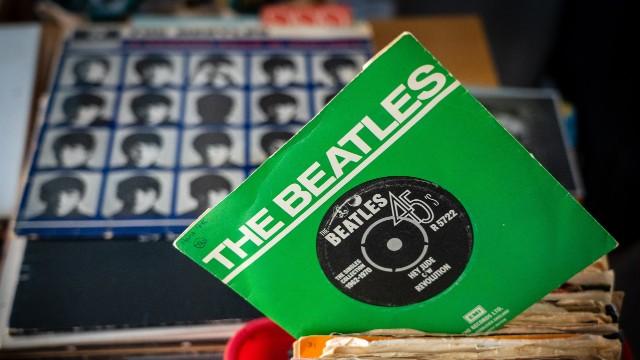
London's rock credentials are hard to beat. Most great rockers have played here, from the Beatles to Oasis.
Clamber aboard our imaginary stretch Limo for a magical mystery tour that takes in five decades of spandex-stretching rock heritage!
The Swinging Sixties

Since the 1960s, when it was called "Swinging London", the city has been the centre of the rock 'n' roll universe.
Back then, The Beatles plotted their pop Revolution at Abbey Road Studios; Jimi Hendrix sadly died at a hotel in Notting Hill; The Kinks wrote a song about a Waterloo Sunset; and The Rolling Stones played concerts at the not-very-big Station Hotel (now Edwards), opposite Richmond train station.
Meanwhile, fashion queen Mary Quant discovered a clever way to save money on fabric and, with the help of the resultant mini-skirt, men discovered that women have legs! The world felt a rush of liberation, the hippy movement began and clothes boutiques from Camden to Carnaby Street became THE place to be seen on a Saturday afternoon.
The Decadent Seventies
While the flowers died and the CND stickers faded, London’s buzz just got louder in the 1970s. It needed to, just to stand a chance of being heard over Led Zeppelin at Camden’s Roundhouse! Then Malcolm McLaren moved the bar yet higher by masterminding The Sex Pistols’ rise to fame from his Sex shop at 430 King’s Road.
The Golden Eighties

The 1980s was the decade of perms and shoulder pads – but try telling Madness that. North London's Madness played many of their early gigs at Camden’s Dublin Castle and they steadfastly refused to follow any fashion but their own. This can be seen on the cover of their Absolutely album, shot outside Camden Town station.
Normal service was resumed with Live Aid, at the old Wembley Stadium. One of the stars of that day, Freddie Mercury, lived at Garden Lodge in Logan Place, until his death in 1991.
Britpop
The 1990s will probably be best remembered for Britpop. One of its main movers was Oasis' Noel Gallagher. His London house was the modestly named Supernova Heights in Steeles Road, NW3 (now owned by Little Britain’s David Walliams).
Elsewhere, Oasis’ sparring partners, Blur were once regular customers at Camden’s Good Mixer pub.
Still Rocking
All of which pretty much brings us up to date. With acts like Babyshambles, Razorlight and Lily Allen, London’s rock ‘n’ roll express train doesn’t look like slowing down just yet. Ten years from now, we’ll probably have hundreds of brand-new landmarks for you to check out. Until then, make do with this little lot:
London Locations: The Fab Four

They may hail from Liverpool but the Beatles spent some of their most important years in London. Cross the famous Abbey Road zebra crossing, on which John, Paul, Ringo and George were photographed for the iconic 1969 album cover for Abbey Road.
The Beatles Coffee Shop is close to Abbey Road Studios and the famous crossing. It's part of St John's Wood Underground Station and is owned by Richard and Irina Porter. Richard has been a Beatles and rock 'n' roll tour guide for the past 15 years so prepare for Beatles-related trivia galore as you munch your sarnies!
Visit 20 Manchester Square, the site of EMI’s old headquarters, where the Fabs posed on the staircase for their Please Please Me album sleeve (EMI dismantled the staircase and took it with them when they moved to new premises in 1995).
Then gaze up at the roof of the former Apple headquarters (3 Savile Row, W1) and try to imagine the Beatles playing their final gig there in 1969.
London Locations: Iconic Album Covers
Ever wondered where that image on the cover of your favourite CD (or even LP) was shot? Well, it just might have been London! David Bowie chose Heddon Street, W1 for the cover of his 1972 Ziggy Stardust and the Spiders from Mars album (Ziggy’s standing outside No 23).
The image on Oasis’ huge-selling 1996 album, (What’s the Story) Morning Glory? was shot in Berwick Street, W1. And artists including The Orb and Pink Floyd have used Battersea Power Station to adorn their covers.
Find out more about London's rock history at the British Museum Experience - an exhibition of British music history.


Games Breaks
Attractions
Theatre Tickets
Dinner & Show